
Early Takeaways from JPM 2026: Energy, Execution and Ecosystems
JPMorgan Healthcare Week 2026 is officially underway, and the energy on the ground is unmistakable. From packed hotel lobbies to impromptu sidewalk meetings, the first days have already reinforced why this week remains the gravitational center of the global life sciences industry. Conversations are fast, candid, and forward-looking - equal parts optimism and realism - as leaders recalibrate around capital efficiency, platform differentiation, and the growing expectation that companies show real traction earlier than ever.
State Bio & Friends Reception: A Powerful Kickoff
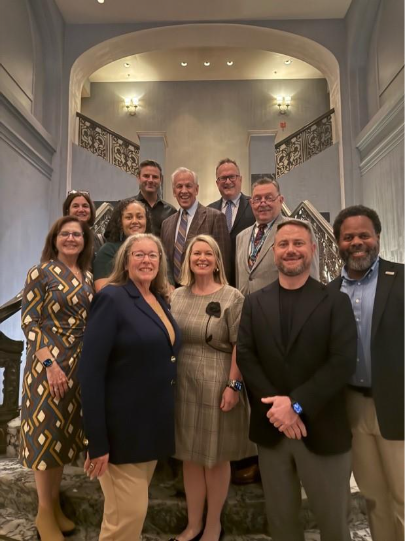
One early highlight was the State Bio & Friends Reception, co-hosted by MichBio along with our sister organizations in AZ, CA (Biocom), CO, GA, OH, NC, NY, NJ, OR, PA, UT and VA, which drew a standing-room-only crowd of more than 700 registrants. The turnout was a powerful signal: states and regions are showing up with confidence, cohesion, and a clear story to tell. The buzz in the room echoed many of the themes heard across JPM this week - renewed investor selectivity, a cautious but real reopening of deal flow, and growing interest in technologies that shorten development timelines or unlock hard biological problems.
There’s also a noticeable shift toward collaboration over hype, with operators trading notes on partnerships, reimbursement realities, and scalable manufacturing.
Michigan on the Street
Michigan is already making its presence felt. Member companies like Akadeum, SxanPro, Sharp and Flat, Entirety Medical, M3D, Daicel Arbor Biosciences, along with others like Espervita, EVOQ Therapeutics, Genomenon, Diapin Therapeutics, CircNova, Decimal Code, MeldHealth, Saros Therapeutics, Sonsvascular, EnexaBio, Skeletalis and Niowave are either presenting, meeting, or being spotted “on the street,” contributing to the steady drumbeat of Michigan innovation woven throughout the week. A special shoutout as well to MichBio Board Directors Ashlea Souffrou and Uma Sharma, and former Board Directors Stephen Goldner and Michael Hagen, as well as Diane Bouis, Dave Repp, Sarah Jameson-Valencia, John Seamans, David Esposito, Earle Holsapple, David Schaffer, Adam Koster, Don Zinn, Fred Brown, Jessica Reed, Mina Sooch, Katherine Kirsch, James Lenger, Adam Havey and Mike Zamiara, whose visibility in the first day of JPM2026 already reflect the depth of leadership coming out of Michigan’s life sciences ecosystem. No doubt, more Michiganders will be seen as the week advances.
Industry Buzz: What People Are Talking About at JPM 2026
Investor sentiment: Many panel group, hallway and reception discussions reflect a more selective capital environment compared to prior years. Investors are increasingly asking for clear pathways to revenue, demonstrable clinical or regulatory milestones, and disciplined burn rates. While early-stage financings haven’t ground to a halt, the bar for attention has risen.
AI & data momentum: Unsurprisingly, digital health and AI-enabled drug discovery platforms remain front and center. But this year’s chatter indicates a growing demand for explainability and real-world validation, not just algorithmic prowess. Companies showcasing tangible case studies or third-party benchmarks are receiving noticeably warmer receptions.
Manufacturing & supply chain resilience: Across panels and fireside chats, there’s renewed emphasis on onshoring critical manufacturing layers, especially for biologics and advanced therapies. Supply chain bottlenecks and regulatory harmonization are top of mind for global operators.
Partnership over acquisition?: While big pharma presence is strong as ever, there’s a recurring theme from multiple sources that strategic partnerships - co-development, revenue-sharing, and pilot agreements - are currently outpacing outright M&A. That said, a few select sectors (e.g., cell/gene therapy enablers and AI drug discovery) are still commanding acquisition interest.
Hiring trends: A number of talent advisors and HR leaders interviewed off-stage suggest continued competition for hybrid skill sets (e.g., clinical + AI fluency, regulatory + commercialization experience), with some companies already planning post-JPM recruiting pushes.
What’s Not Happening (Yet)
Mega-deals: Unlike a few past years where headlines were dominated by billion-dollar acquisitions or SPAC follow-ons, the early days of JPM 2026 have been relatively quiet on the blockbuster deal front. Observers describe this as calm before the close, not a lack of intent - but it’s notable compared to prior buzz.
Overheated valuations: There’s been an observable pullback in valuation exuberance across the corridor. Investors are returning to fundamentals-driven discussions, especially for Series A and B rounds.
Unrealistic timelines: A number of founders on panels and in casual hallway chatter have joked about how unrealistic “hyper-aggressive” development timelines are now greeted with laughs instead of applause. The focus this year seems anchored in feasible, risk-adjusted roadmaps.
The Headwinds Beneath the Buzz
Threaded through many of the most candid conversations at JPM 2026—often off-stage and between meetings—are growing concerns about the policy and geopolitical forces shaping the next decade of innovation.
In Washington, uncertainty around drug pricing reforms, MFN-style reference pricing, and the expanding reach of CMS continues to cast a long shadow over pipeline planning. Founders and pharma executives alike are voicing frustration that shifting reimbursement assumptions are forcing programs to be delayed, re-scoped, or deprioritized altogether. At the same time, evolving FDA expectations, stretched review capacity, and regulatory ambiguity for novel modalities are adding friction to development timelines - particularly for smaller companies without the balance sheets to absorb prolonged delays.
The net effect? Capital is becoming more cautious not just about science risk, but policy risk. Several investors noted that promising assets are now being evaluated through a much harsher lens: Will this still make sense if pricing pressure intensifies? Will CMS coverage lag FDA approval? These questions are influencing deal structures, partnership terms, and even which therapeutic areas get funded in the first place.
Compounding those domestic pressures is a global reality that many at JPM 2026 are openly acknowledging: China is rapidly outpacing the U.S. in coordinated investment across the life sciences value chain. From advanced manufacturing and CDMO capacity to AI-enabled drug discovery and clinical trial execution, China’s pace - and scale - of capital deployment is becoming impossible to ignore. Multiple observers pointed out that while the U.S. still leads in breakthrough science and entrepreneurial talent, fragmentation across funding, regulation, and policy is creating gaps others are quick to exploit. However, a continued lack of a national strategic focus on supporting and growing the U.S. bio-industry will have a long-term deleterious impact on its viability.
What This Means for Innovation
Against this backdrop, JPM 2026 feels less like a celebration of excess and more like a strategic recalibration moment for the industry.
Innovation isn’t slowing - but it is becoming more selective, more regionalized, and more dependent on ecosystems that can help companies navigate complexity. That’s where state and regional organizations, manufacturing hubs, translational infrastructure, and aligned public–private partnerships are stepping into a more critical role. The strong showing at the State Bio & Friends Reception underscored this shift: ecosystems aren’t just talent pipelines anymore - they’re risk mitigators.
For companies, the message is clear. Success now requires not only great science, but policy fluency, capital discipline, and operational realism. For investors and strategic partners, the focus is shifting toward platforms and teams that can survive - and adapt - amid regulatory, pricing, and geopolitical uncertainty.
And for regions like Michigan, JPM 2026 is reinforcing a powerful opportunity: to position themselves as places where innovation can still move forward efficiently, responsibly, and at scale - despite the headwinds.
Early impressions are clear: JPM 2026 is a blend of optimism and pragmatism. Leaders are showing up ready to build, evaluate, and invest - but with a sharper eye on execution and measurable progress.
If the opening moments are any indication, this is shaping up to be a week defined not just by deals and decks, but by meaningful connections, grounded ambition, and regions like Michigan confidently claiming their seat at the global table.
